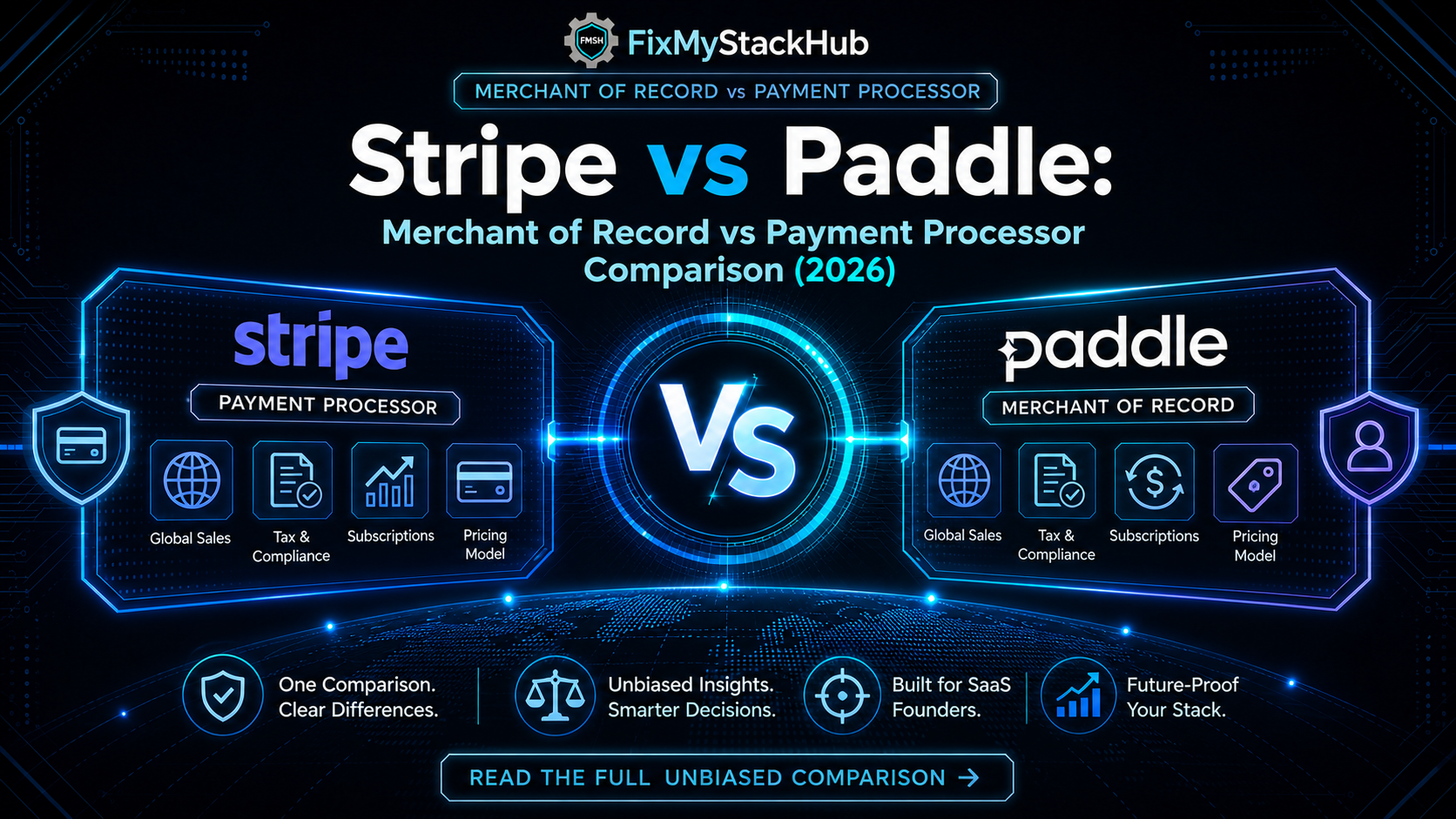
Choosing between Stripe vs Paddle is a critical decision for SaaS companies managing global payments, subscriptions, and compliance requirements. While both platforms help businesses accept payments online, they operate under fundamentally different models. Stripe provides developer-first payment infrastructure, while Paddle acts as a Merchant of Record, handling taxes, billing compliance, and global revenue operations on behalf of software companies.
In this FixMyStackHub comparison, we break down Stripe vs Paddle across pricing philosophy, integrations, scalability, and operational responsibility so you can determine which billing platform aligns best with your product, growth stage, and international expansion strategy.
QUICK COMPARISON TABLE
| Category | Stripe | Paddle |
|---|---|---|
| Core Model | Payment Processor | Merchant of Record (MoR) |
| Ideal Customer | Developer-focused SaaS & startups | SaaS companies selling globally |
| Tax Handling | Requires Stripe Tax or manual setup | Fully managed tax & compliance |
| Checkout Flexibility | Highly customizable APIs | Simpler hosted checkout |
| Pricing Model | Transaction-based fees | Revenue-share model |
| Compliance Responsibility | Merchant handles legal obligations | Paddle assumes reseller liability |
What is Stripe?
Stripe is a developer-first payment infrastructure platform designed to help businesses build flexible billing and checkout systems. It offers powerful APIs, subscription management, and deep integrations that allow teams to fully customize payment experiences. Many startups and enterprises choose Stripe because it provides granular control over pricing logic, billing workflows, and payment data.
Stripe works particularly well for teams that want ownership over their payment stack and are comfortable managing compliance responsibilities such as tax collection and regional regulations.
What is Paddle?
Paddle is a Merchant of Record platform built specifically for SaaS and digital product companies. Instead of acting purely as a payment processor, Paddle becomes the legal reseller of your software, managing tax calculation, invoicing, and global compliance obligations on your behalf.
This model reduces operational overhead for companies expanding internationally, making Paddle attractive for teams that want a simplified billing experience without managing complex financial regulations internally.
Stripe vs Paddle: Key Differences
| Feature Area | Stripe | Paddle |
|---|---|---|
| Payment Model | Infrastructure for payments | Merchant of Record reseller model |
| Developer Control | Full customization via APIs | Limited customization but easier setup |
| Global Tax Compliance | Requires additional configuration | Built-in tax & compliance management |
| Billing Flexibility | Advanced subscription logic | Simplified SaaS billing workflows |
| Ideal Team Type | Engineering-heavy teams | Growth-focused SaaS teams |
While both platforms support subscription billing, Stripe vs Paddle ultimately comes down to whether you want full control over payments or prefer outsourcing compliance complexity through a Merchant of Record model.
Pros and Cons
| Category | Stripe | Paddle |
|---|---|---|
| Strengths | Extremely flexible APIs Large integration ecosystem Strong developer tooling |
Handles taxes and compliance Simplifies global expansion Designed for SaaS monetization |
| Limitations | Requires managing compliance responsibilities More setup required |
Higher fees compared to processors Less checkout customization |
Which One Should You Choose?
Choose Stripe if you want maximum control over your billing logic, custom checkout experiences, and deep integration into your product infrastructure. Choose Paddle if your priority is simplifying global SaaS billing, reducing tax complexity, and outsourcing compliance responsibilities while focusing on product growth.
Learn more directly from the official Stripe and Paddle platform here.
You may also want to compare Zapier vs Make if automation is part of your revenue operations stack.