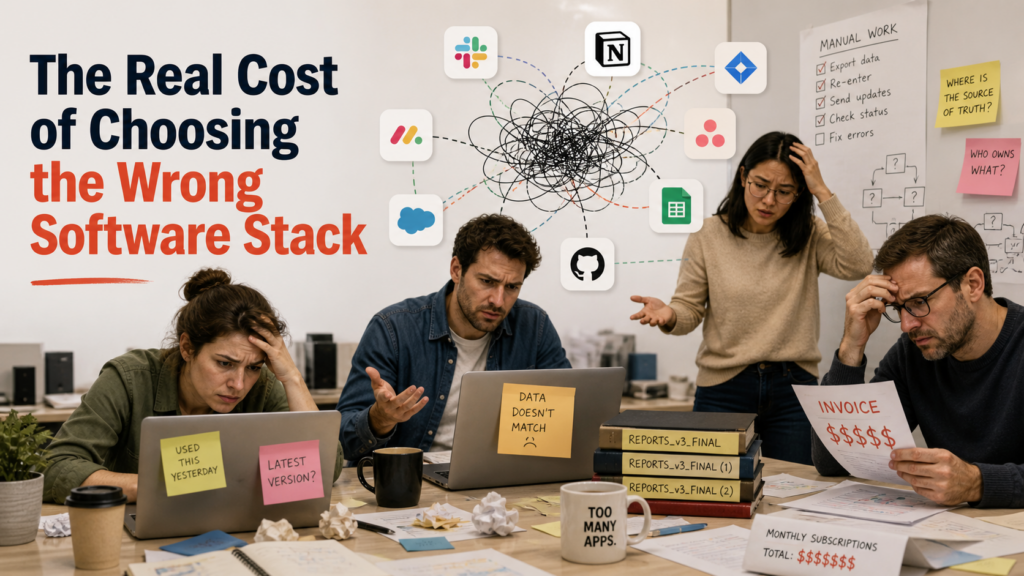
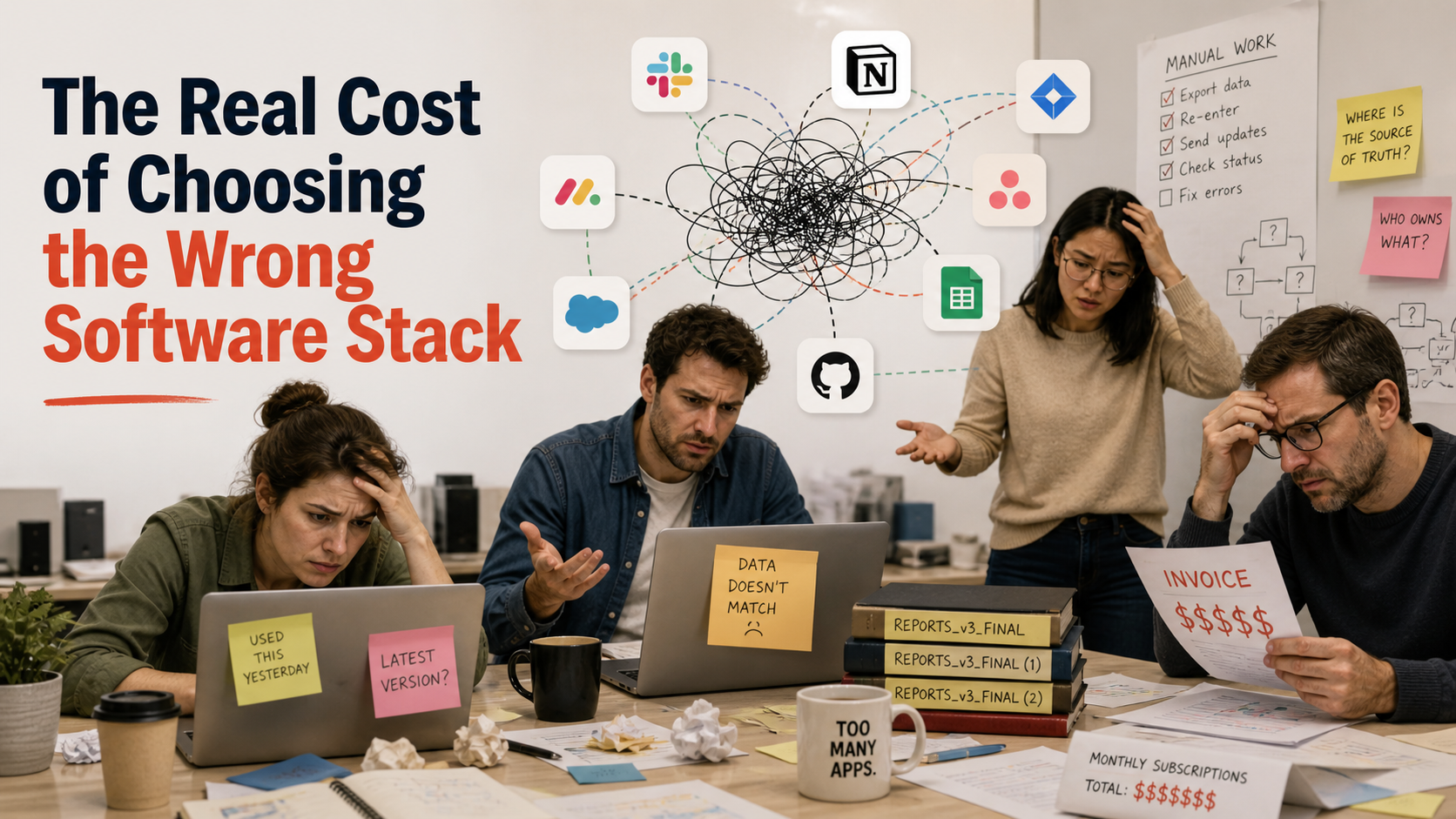
When businesses choose the wrong software stack, the damage rarely appears all at once. It usually starts with friction. A tool does not integrate properly. Teams create workarounds. Data becomes inconsistent. Adoption slows down. Costs rise quietly.
That is what makes poor software decisions so expensive. The license fee is only one part of the picture. The real cost often shows up in lost time, duplicate work, security exposure, user frustration, and reduced momentum across teams.
For businesses scaling across multiple systems, the wrong stack can slow down growth far more than expected.
Wasted spend is only the beginning
The easiest cost to notice is financial. A business may end up paying for tools that overlap, licenses that go unused, or enterprise features that were never really needed.
But financial waste is often the smallest visible part of the problem. Once a business has committed to the wrong tool, switching becomes harder. Teams have already built processes around it. Data has already been moved. Stakeholders are already invested.
That makes the true cost much harder to unwind.
Poor stack decisions create operational drag
A misaligned stack makes everyday work slower. Teams spend more time jumping between tools, resolving inconsistencies, and compensating for integration gaps.
Instead of enabling better workflows, the stack starts to create resistance. That can affect support, reporting, onboarding, collaboration, and decision-making. Even small workflow issues become expensive when they happen every day across multiple users.
Risk increases when tools do not fit
This is especially true for platforms handling sensitive data, identity, compliance, or access management. When tools are added without enough consideration for security, the result may be fragmented controls, inconsistent visibility, or unclear ownership across systems.
The wrong stack does not just waste money. It can also increase business risk.
How businesses can reduce stack mistakes
The best way to reduce stack mistakes is to slow down the buying process before commitment. That means comparing tools properly, checking integration fit, understanding trade-offs, and asking what the business will actually need six to twelve months from now.
A clearer decision at the start is usually cheaper than a migration later.
Final takeaway
The real cost of the wrong software stack is not just the subscription. It is the friction, risk, inefficiency, and lost confidence that follow.
Explore FixMyStackHub comparisons before you commit to the wrong platform.