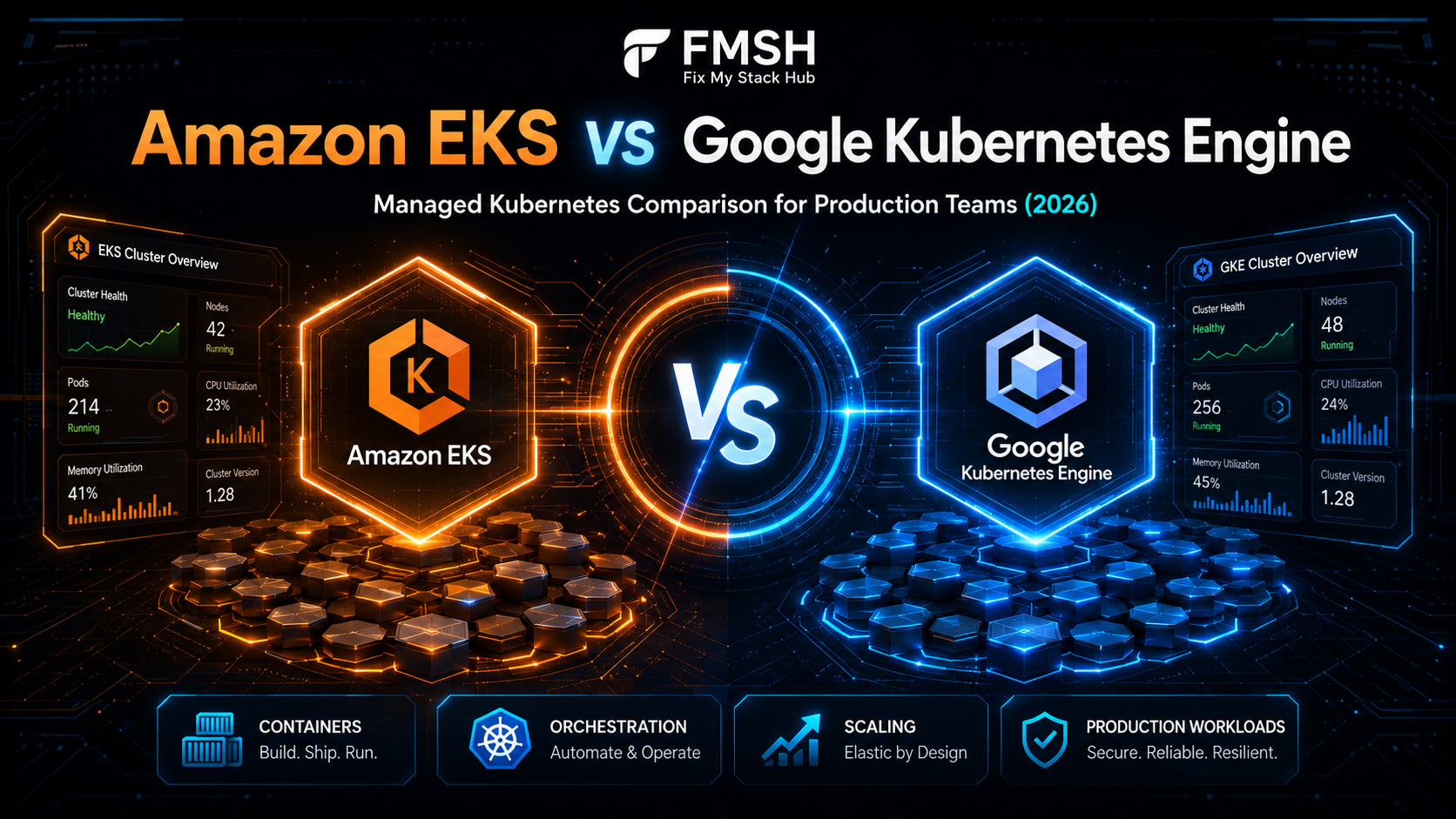
Choosing between Amazon EKS and Google Kubernetes Engine is a major managed Kubernetes decision for production teams. Both platforms help teams run Kubernetes at scale, but they are positioned differently. Amazon EKS emphasizes standardized Kubernetes management across cloud, on-premises, and edge environments with strong AWS integration, while GKE emphasizes being the industry’s first fully managed Kubernetes service with strong autoscaling, multi-cluster support, and Google’s Kubernetes heritage.
That means the comparison is not just about who can create a cluster faster. Buyers need to think about Kubernetes operating model, automation depth, multi-environment consistency, cloud ecosystem fit, and whether they want Kubernetes inside AWS breadth or a platform that leans harder into Google’s long-standing Kubernetes strengths. In this FixMyStackHub comparison, we break down Amazon EKS vs GKE across platform operations, automation, and business fit.
QUICK COMPARISON TABLE
| Category | Amazon EKS | Google Kubernetes Engine |
|---|---|---|
| Core Purpose | Managed Kubernetes on AWS and across more environments | Fully managed Kubernetes on Google Cloud |
| Ideal Customer | Teams already invested in AWS services and multi-environment Kubernetes operations | Teams wanting a polished managed Kubernetes experience with strong autoscaling and Google-native alignment |
| Automation Story | Strong automation with EKS Auto Mode and AWS service integration | Strong autoscaling and automated lifecycle management |
| Environment Reach | Cloud, on-premises, and edge emphasis | Google Cloud-first with strong production Kubernetes experience |
| Product Feel | AWS-native Kubernetes platform | Google-native Kubernetes platform |
| Best Fit | AWS-centered production teams | Teams wanting deeply managed Kubernetes on Google Cloud |
What is Amazon EKS?
Amazon EKS is AWS’s managed Kubernetes service. AWS positions it as a way to run Kubernetes across AWS and on-premises environments with standardized tooling and operations, while also using features like EKS Auto Mode to automate cluster management for compute, storage, and networking.
Teams often choose EKS when Kubernetes is part of a broader AWS operating model and they want strong integration with AWS services and infrastructure patterns.
What is Google Kubernetes Engine?
Google Kubernetes Engine is Google Cloud’s managed Kubernetes platform. Google highlights GKE as a fully managed Kubernetes service with strong autoscaling, release channels, multi-cluster support, and deep alignment with Google’s Kubernetes history and production-scale operations experience.
Organizations often choose GKE when they want a highly managed Kubernetes experience inside Google Cloud with strong automation and scaling behavior.
Amazon EKS vs Google Kubernetes Engine: Key Differences
| Feature Area | Amazon EKS | Google Kubernetes Engine |
|---|---|---|
| Platform Identity | AWS-native managed Kubernetes | Google-native fully managed Kubernetes |
| Operating Style | Kubernetes with strong AWS ecosystem integration | Kubernetes with strong managed automation and Google heritage |
| Environment Reach | Emphasizes cloud, on-premises, and edge consistency | Emphasizes managed Kubernetes excellence inside Google Cloud |
| Automation Depth | Strong, especially with EKS Auto Mode | Strong autoscaling and managed lifecycle operations |
| Best Fit | AWS-centric production platform teams | Google Cloud-centric Kubernetes teams |
The main difference is ecosystem alignment plus operating style. Amazon EKS often makes more sense for teams already invested in AWS services and multi-environment Kubernetes operations. GKE often makes more sense for teams that want a strongly managed Kubernetes experience inside Google Cloud with deep autoscaling and lifecycle management strengths.
Pros and Cons
| Category | Amazon EKS | Google Kubernetes Engine |
|---|---|---|
| Strengths | Strong AWS integration Cloud, on-prem, and edge story EKS Auto Mode simplifies cluster operations | Strong managed Kubernetes heritage Autoscaling and lifecycle management strengths Excellent Google Cloud fit |
| Limitations | Best fit is strongest for AWS-centered platform teams | Best fit is strongest for Google Cloud-centered Kubernetes strategies |
Which One Should You Choose?
Choose Amazon EKS if your priority is Kubernetes inside a broader AWS operating model, especially across cloud and hybrid environments.
Choose Google Kubernetes Engine if your priority is a highly managed Kubernetes experience with strong autoscaling and Google Cloud alignment.
Related Comparison
You may also want to compare AWS vs Google Cloud if the bigger cloud platform decision is still unresolved.
Official Links
Amazon EKS official site and Google Kubernetes Engine official site.