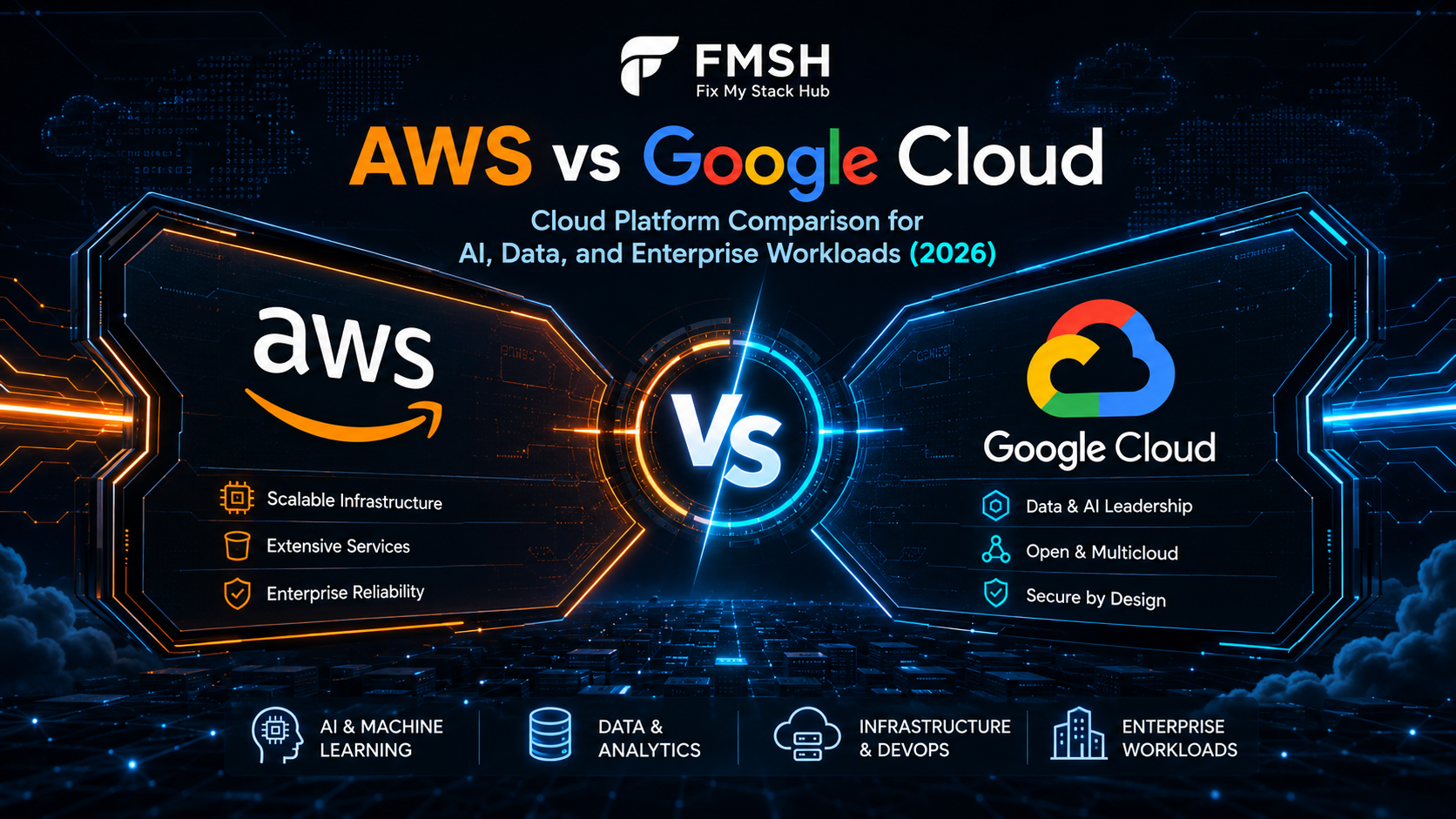
Choosing between AWS and Google Cloud is a major cloud platform decision for modern businesses. Both vendors offer broad infrastructure, AI, analytics, and developer services, but they are framed differently. AWS positions itself as a broad cloud platform with deep infrastructure, analytics, and generative AI options, while Google Cloud positions itself around AI, security, data management, and hybrid and multi-cloud services.
That means the comparison is not just about who has more cloud services. Buyers need to think about AI maturity, analytics priorities, enterprise workload patterns, hybrid needs, and whether they want the broadest general-purpose cloud platform or a cloud platform with especially strong AI and data positioning. In this FixMyStackHub comparison, we break down AWS vs Google Cloud across infrastructure breadth, AI, data, and business fit.
QUICK COMPARISON TABLE
| Category | AWS | Google Cloud |
|---|---|---|
| Core Purpose | Broad cloud platform for infrastructure, analytics, and AI | Cloud platform focused on AI, data, security, and hybrid services |
| Ideal Customer | Enterprises wanting broad infrastructure choice across many workload types | Teams prioritizing AI, analytics, and data-centric cloud architecture |
| AI Positioning | Generative AI with broad model and infrastructure options | Strong AI and data platform story with Google ecosystem alignment |
| Data & Analytics | Broad analytics coverage across many workload types | Very strong data and analytics orientation |
| Hybrid Story | Broad infrastructure and ecosystem depth | Clear hybrid and multi-cloud positioning |
| Best Fit | Broad enterprise cloud adoption across mixed workloads | AI, analytics, and modern data-driven cloud strategies |
What is AWS?
AWS is a broad cloud computing platform with services across infrastructure, analytics, AI, storage, databases, and application development. Its AI messaging especially emphasizes enterprise-grade security and privacy, broad model choice, and tooling for building and scaling generative AI customized to business data and use cases.
Teams often choose AWS when they want the broadest general-purpose cloud platform and deep service coverage across infrastructure, storage, networking, data, and AI.
What is Google Cloud?
Google Cloud is positioned around AI, cloud computing, security, data management, and hybrid and multi-cloud services. Its AI and data story is especially strong, making it attractive to teams that want cloud architecture tightly tied to analytics, machine learning, and modern data workflows.
Organizations often choose Google Cloud when AI, analytics, and hybrid or multi-cloud architecture are central to the platform decision.
AWS vs Google Cloud: Key Differences
| Feature Area | AWS | Google Cloud |
|---|---|---|
| Platform Identity | Broad general-purpose cloud platform | AI, data, and hybrid-forward cloud platform |
| Infrastructure Breadth | Very broad service catalog across enterprise workloads | Strong cloud coverage with sharper focus on AI and analytics strengths |
| AI Story | Model choice and infrastructure flexibility | Deep AI integration and data cloud synergy |
| Data Strategy | Broad analytics and data tooling | Very strong analytics-led positioning |
| Best Fit | Mixed workload enterprises wanting maximum cloud coverage | AI and data-first cloud buyers |
The main difference is center of gravity. AWS often makes more sense for organizations that want maximum cloud breadth across many workload types. Google Cloud often makes more sense for teams whose cloud strategy is especially shaped by AI, analytics, modern data architecture, and hybrid or multi-cloud needs.
Pros and Cons
| Category | AWS | Google Cloud |
|---|---|---|
| Strengths | Broadest cloud platform feel Strong infrastructure depth Wide AI and analytics coverage | Strong AI and data positioning Clear hybrid and multi-cloud story Good fit for modern analytics-heavy workloads |
| Limitations | Breadth can feel heavier for buyers with narrower AI/data priorities | May appeal most to buyers already leaning toward AI and data-led cloud strategies |
Which One Should You Choose?
Choose AWS if your priority is broad enterprise cloud coverage across many workload types and infrastructure styles.
Choose Google Cloud if your priority is AI, analytics, modern data architecture, and a strong hybrid or multi-cloud story.
Related Comparison
You may also want to compare Google Cloud vs Microsoft Azure if your shortlist is focused on AI, hybrid, and enterprise platform strategy.
Official Links
AWS official site and Google Cloud official site.