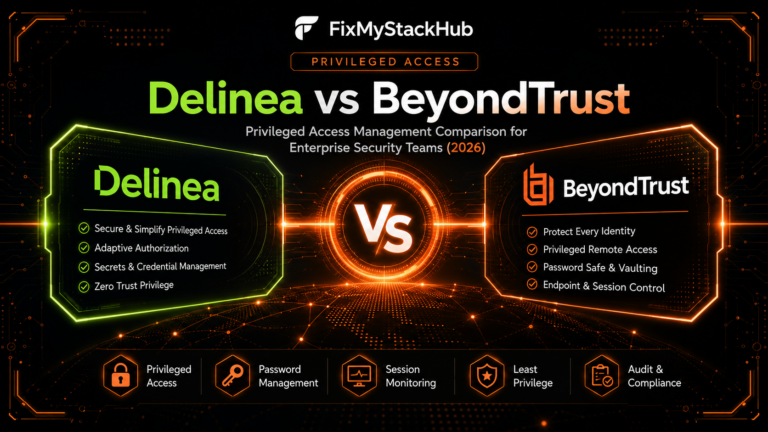

Choosing between CyberArk and BeyondTrust is a serious decision for enterprise security teams evaluating privileged access management. Both platforms aim to reduce privileged access risk, secure sensitive credentials, and improve oversight of privileged sessions, but they are not identical in how they approach those goals.
CyberArk is often seen as the enterprise heavyweight in PAM, while BeyondTrust is frequently considered by teams looking for broader privileged access visibility with a different operational feel. In this FixMyStackHub comparison, we break down CyberArk vs BeyondTrust across vaulting, session management, deployment complexity, compliance support, and enterprise fit.
QUICK COMPARISON TABLE
| Category | CyberArk | BeyondTrust |
|---|---|---|
| Core Purpose | Enterprise privileged access management | Privileged access management and secure remote access |
| Ideal Customer | Large enterprises with mature PAM needs | Enterprises wanting PAM plus broader privileged access visibility |
| Vaulting | Strong enterprise-grade vaulting | Strong vaulting with broader access context |
| Session Management | Advanced privileged session controls | Strong session oversight and access monitoring |
| Complexity | Often more complex to deploy and manage | Can feel more approachable depending on use case |
| Best Fit | Deep PAM programs in enterprise environments | Teams wanting PAM with wider access management visibility |
What is CyberArk?
CyberArk is a privileged access management platform designed to protect, manage, and monitor access to highly sensitive accounts, credentials, and sessions. It is widely used by enterprise security teams that need deep control over privileged access in regulated or security-sensitive environments.
CyberArk is often selected when privileged access is treated as a major strategic security layer, especially in complex enterprise environments where governance, rotation, vaulting, and session monitoring need to be tightly controlled.
What is BeyondTrust?
BeyondTrust offers privileged access and remote access security solutions designed to reduce privileged account risk while improving visibility into access activity across systems and users.
Organizations often consider BeyondTrust when they want PAM capabilities, but also value the broader context of access, support, and remote privileged usage. It can appeal to teams looking for strong security controls with a different implementation or operational style than CyberArk.
CyberArk vs BeyondTrust: Key Differences
| Feature Area | CyberArk | BeyondTrust |
|---|---|---|
| PAM Depth | Very strong enterprise-grade PAM depth | Strong PAM with broader access visibility angle |
| Deployment Model | Often heavier and more enterprise-oriented | Can feel more flexible depending on environment |
| Session Control | Advanced privileged session management | Strong session oversight and access monitoring |
| Admin Experience | Can require higher maturity and more specialist skill | Often seen as more approachable in some scenarios |
| Best Use Case | Deep enterprise PAM programs | PAM plus wider privileged access oversight |
The biggest difference is usually operational. CyberArk is often the stronger fit for mature enterprise PAM programs where deep control is the priority. BeyondTrust may make more sense where teams want strong PAM capabilities but also a broader view of privileged access and support workflows.
Pros and Cons
| Category | CyberArk | BeyondTrust |
|---|---|---|
| Strengths | Deep PAM capabilities Strong enterprise reputation Advanced vaulting and session controls | Broad privileged access coverage Strong monitoring and remote access relevance Can feel more flexible in some environments |
| Limitations | Can be complex to deploy and manage Often better suited to larger mature teams | May not always match CyberArk’s depth in highly complex enterprise PAM scenarios |
Which One Should You Choose?
Choose CyberArk if your top priority is deep privileged access control in a mature enterprise security environment.
Choose BeyondTrust if you want strong PAM capabilities with broader privileged access visibility and a potentially more approachable operational fit.
Related Comparison
You may also want to compare Microsoft Entra ID vs Okta if your identity strategy is broader than privileged access alone.