Choosing between DigitalOcean and AWS is often less about raw cloud capability and more about operational philosophy. AWS is built for massive breadth and scale, while DigitalOcean positions itself around a simpler cloud experience with a unified stack, one API, one bill, and easier builder-focused workflows. DigitalOcean’s current positioning also emphasizes its AI-native cloud direction, while AWS continues to present itself as a broad, reliable, scalable cloud platform.
That makes this comparison especially relevant for startups, lean engineering teams, and businesses deciding whether they need hyperscaler depth right now or something easier to operate. In this FixMyStackHub comparison, we break down DigitalOcean vs AWS across usability, platform depth, pricing logic, developer fit, and growth-stage suitability.
QUICK COMPARISON TABLE
| Category | DigitalOcean | AWS |
|---|---|---|
| Core Purpose | Simpler cloud platform for builders and growing teams | Broad hyperscale cloud platform |
| Ideal Customer | Startups, SMBs, and lean engineering teams | Businesses needing very broad cloud capabilities |
| Platform Complexity | Lower complexity and more streamlined experience | Much broader and more complex |
| AI / Modern Platform Pitch | AI-native cloud with unified stack positioning | Broad cloud platform with extensive services |
| Pricing Feel | Simpler and easier to reason about | Flexible but often more complex to optimize |
| Best For | Teams wanting simplicity and fast execution | Teams needing depth, scale, and broad service choice |
What is DigitalOcean?
DigitalOcean is a cloud platform that currently describes itself as an AI-native cloud with a unified stack for builders, emphasizing one API, one bill, and simplified cloud operations. Its positioning is strongly builder-oriented and focused on making cloud infrastructure easier to use and easier to scale.
Businesses often choose DigitalOcean when they want a less intimidating cloud environment, cleaner pricing logic, and infrastructure that supports fast delivery without the operational sprawl that can come with a much larger platform.
What is AWS?
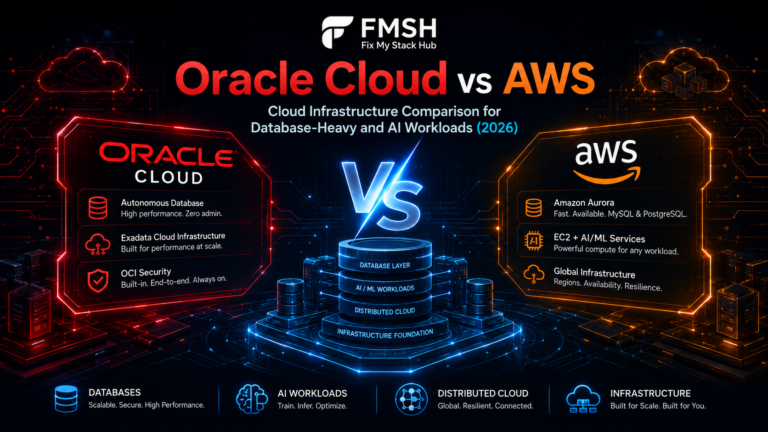
AWS is Amazon’s cloud platform, known for a very broad range of services across compute, storage, networking, data, AI, security, and more. AWS presents itself as a reliable, scalable, pay-as-you-go cloud platform for many types of workloads.
Organizations often choose AWS when they need service depth, broad architecture options, large-scale infrastructure flexibility, and long-term cloud headroom across many technical use cases.
DigitalOcean vs AWS: Key Differences
| Feature Area | DigitalOcean | AWS |
|---|---|---|
| Operational Style | Simpler and more streamlined | Broader and more complex |
| Platform Depth | Focused and builder-friendly | Extremely broad service portfolio |
| Pricing Feel | Easier to understand | More flexible, but often harder to optimize |
| Team Fit | Startups and lean teams | Enterprises and complex architectures |
| Best Use Case | Fast-moving teams wanting simplicity | Businesses needing maximum platform depth |
The biggest difference is complexity versus capability breadth. DigitalOcean usually makes more sense when the team wants speed, clarity, and fewer moving parts. AWS usually makes more sense when the business expects broad infrastructure needs, architectural complexity, or rapid long-term expansion across many services.
Pros and Cons
| Category | DigitalOcean | AWS |
|---|---|---|
| Strengths | Simpler cloud experience Builder-friendly positioning Easier pricing feel | Broadest service depth Strong scale and flexibility Powerful long-term cloud platform |
| Limitations | Less broad than a hyperscaler | Can be overwhelming for smaller teams |
Which One Should You Choose?
Choose DigitalOcean if your team values simplicity, faster operational clarity, and infrastructure that is easier to manage without deep cloud specialization.
Choose AWS if you need maximum cloud breadth, more architecture options, and the ability to grow into a much wider service ecosystem over time.
Related Comparison
You may also want to compare AWS vs Microsoft Azure if your shortlist includes the two largest enterprise cloud platforms.