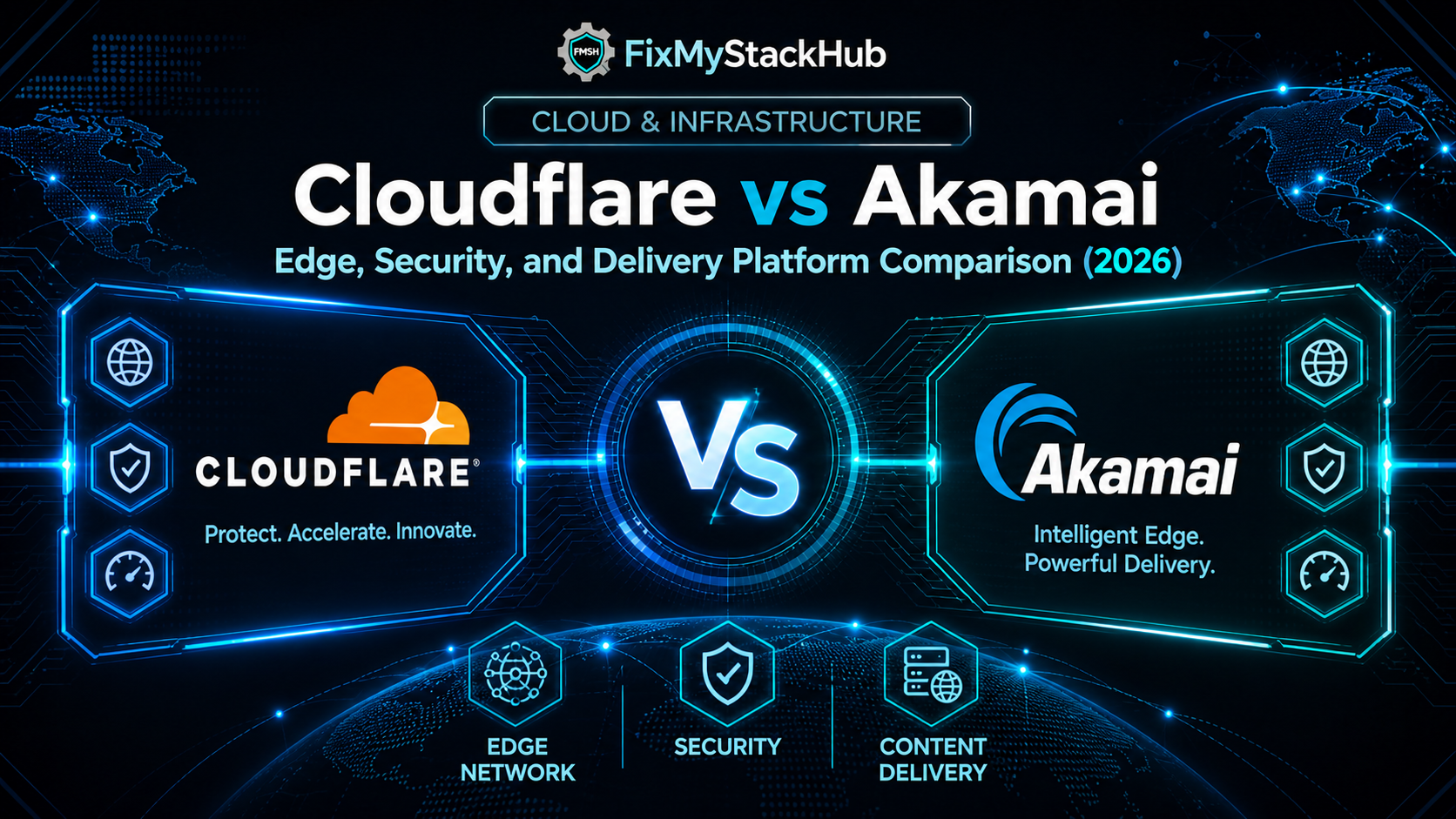
Choosing between Cloudflare and Akamai often means choosing between two major edge and delivery players with different platform identities. Cloudflare positions itself around a “connectivity cloud” with more than 60 services on one unified platform, while Akamai positions itself as a globally distributed cloud computing platform and edge network focused on performance, reliability, and security.
That means the comparison is no longer just about CDN delivery. Buyers often need to think about platform breadth, security services, edge architecture, and whether they want a more unified modern interface or a more traditional enterprise-grade edge and delivery provider. In this FixMyStackHub comparison, we break down Cloudflare vs Akamai across delivery, security, platform scope, and business fit.
QUICK COMPARISON TABLE
| Category | Cloudflare | Akamai |
|---|---|---|
| Core Purpose | Connectivity cloud with security, networking, and build services | Distributed cloud computing, security, and content delivery platform |
| Ideal Customer | Teams wanting unified modern edge/security platform | Enterprises needing globally distributed delivery and edge capabilities |
| Platform Scope | Broad unified platform | Broad distributed platform with strong enterprise heritage |
| Security Positioning | Security built into connectivity cloud model | Security, delivery, and performance at global scale |
| Best Fit | Modern platform consolidation at the edge | Large-scale enterprise delivery and edge operations |
| Brand Identity | Unified platform simplicity | Enterprise-grade distributed infrastructure |
What is Cloudflare?
Cloudflare describes itself as a connectivity cloud that helps organizations connect, protect, and build on one unified platform. Its official positioning highlights more than 60 cloud services delivered through its network and a simpler interface for connecting users, apps, clouds, and networks.
Teams often choose Cloudflare when they want to consolidate networking, performance, and security services into a platform that feels modern and unified.
What is Akamai?
Akamai describes itself as a cloud computing, security, and content delivery company with the world’s most distributed cloud computing platform and edge network. Its current cloud positioning also emphasizes globally distributed infrastructure for AI, edge workloads, and built-in security and delivery.
Businesses often choose Akamai when they need large-scale delivery, enterprise-grade edge infrastructure, and a provider with deep heritage in performance and global content distribution.
Cloudflare vs Akamai: Key Differences
| Feature Area | Cloudflare | Akamai |
|---|---|---|
| Platform Identity | Unified connectivity cloud | Distributed cloud + edge network |
| User Experience | More platform-consolidation oriented | More enterprise-distributed infrastructure oriented |
| Edge Positioning | Broad modern edge/security/build platform | Deep enterprise edge and delivery foundation |
| Security Integration | Built into platform identity | Built into global delivery and edge model |
| Best Fit | Teams wanting one modern platform | Enterprises with large-scale delivery and edge needs |
The biggest difference is platform framing. Cloudflare often makes more sense for teams looking to consolidate edge, networking, and security services into a unified experience. Akamai often makes more sense for enterprises that prioritize large-scale global delivery and edge capability rooted in a long-standing distributed infrastructure model.
Pros and Cons
| Category | Cloudflare | Akamai |
|---|---|---|
| Strengths | Unified platform approach Broad security/networking scope Modern connectivity cloud positioning | Strong global distribution Enterprise-grade delivery reputation Broad edge and cloud infrastructure |
| Limitations | May feel newer in some enterprise procurement contexts | Can feel more traditional and enterprise-heavy |
Which One Should You Choose?
Choose Cloudflare if your priority is a unified edge, networking, and security platform with a modern consolidation story.
Choose Akamai if you need large-scale global delivery and enterprise-grade edge infrastructure with deep distributed network heritage.
Related Comparison
You may also want to compare Datadog vs New Relic if observability and infrastructure visibility are also part of your cloud platform decision.